
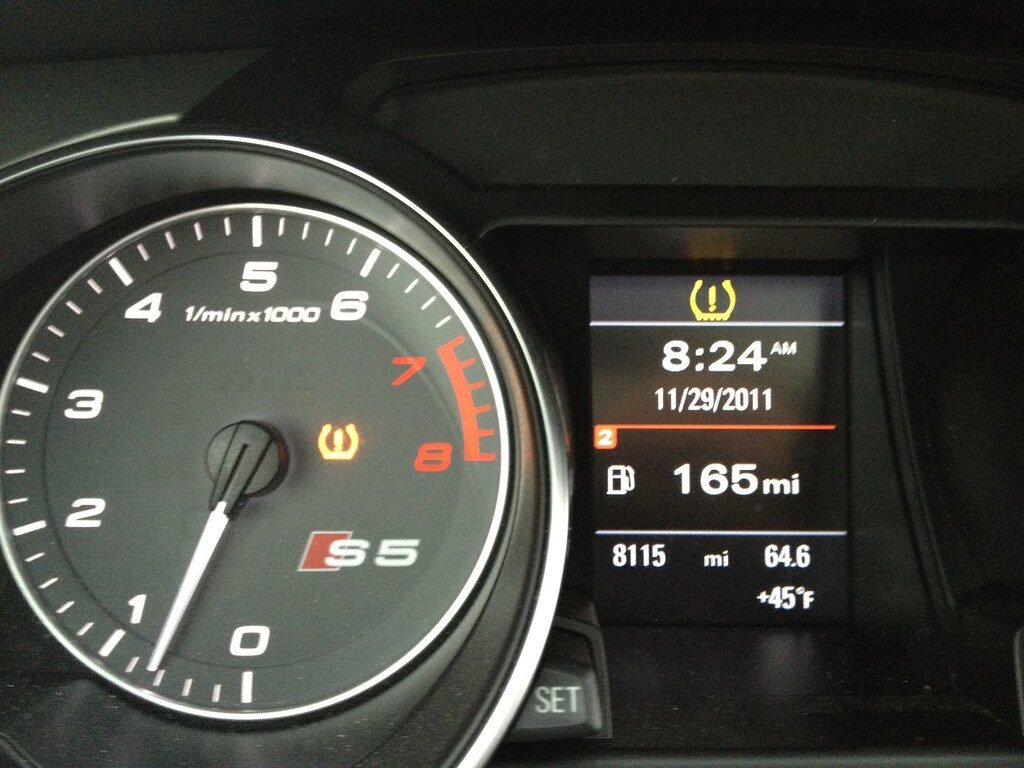
Quick answer: TPMS stands for Tire Pressure Monitoring System, and the light means at least one tire has dropped roughly 25% below its recommended pressure. Check all four tires with a gauge, fill to the number on your door-jamb sticker, and the light should clear within a few miles. If it keeps coming back, you have a leak — not a weather fluke.
That little horseshoe-with-an-exclamation-point on your dash confuses more drivers than any other warning light — plenty of people have owned their car for years without knowing what it’s called. Here’s what the TPMS light actually means, what usually sets it off, and how to tell a two-minute fix from a tire that needs attention before your next drive.
What TPMS means and how it works
TPMS is your car’s Tire Pressure Monitoring System. Its whole job is to watch the air in your tires and warn you when one or more drops below a safe range — typically about 25 percent under the recommended pressure. Most vehicles use a small battery-powered sensor mounted inside each wheel; some estimate pressure indirectly through the ABS wheel-speed sensors instead. Either way, when the light comes on, the system is telling you one thing: check the tires.
Solid or flashing? Read the light first
Before you reach for the air hose, notice how the light behaves. A steady light almost always means low pressure — fix the air, and it goes out. A light that flashes for 60 to 90 seconds at startup and then stays lit means the system itself has a fault, usually a dead sensor battery, and no amount of air will clear it — it needs a scan. We break this down fully in our guide to the solid vs. flashing TPMS light.
The usual suspects behind the light
- Cold weather — pressure falls about 1 psi for every 10°F drop, so the first cold morning of fall trips a lot of lights
- A nail or screw causing a slow leak
- A leaking or corroded valve stem
- Pressures never set right after recent tire work
- A worn-out sensor battery, common once sensors hit 5 to 10 years old
The two-minute fix to try first
Check all four tires with a gauge while they’re cold — before driving, or at least three hours after parking. Fill each one to the pressure on the sticker inside the driver’s door jamb, not the big number molded into the tire sidewall. The sidewall number is the tire’s maximum, not your car’s spec, and it’s usually too high. Once the pressures are right, give it a few miles of driving; most systems reset on their own.
Curious why the “right” pressure matters beyond turning off a light? Our guide on why tire pressure checks matter covers what low pressure quietly costs you.
A light that keeps returning is a message
If the light comes back days after you aired up, stop topping off and start looking for the leak — a nail, a bad valve stem, or corrosion where the tire seals to the wheel. Driving on chronically low pressure wears the tire’s shoulders fast, dulls your braking and handling, and costs fuel. And the slow leak that “isn’t that bad” has a way of becoming a flat on the worst possible morning.
When it’s time for a professional look
Bring the car in if the light returns after adding air, if it flashes at startup, if one tire visibly sits lower than the rest, or if the car pulls or rides rough. Each of those points to something a gauge alone won’t fix.
TPMS questions, answered
Is it safe to drive with the TPMS light on?
Driving a short distance to get air is fine. Continuing to drive on an unknown low tire is not — a badly underinflated tire builds heat, wears fast, and can fail at highway speed. Check the pressure as soon as you reasonably can.
Why is the light on when my tires look fine?
Because your eyes are a terrible pressure gauge — a tire can be 8 to 10 psi low and look perfectly normal. Cold mornings are the classic trigger. It can also be a dying sensor rather than low air, which is why a gauge (and sometimes a scan) beats a walk-around.
How long do TPMS sensors last?
The sealed batteries inside typically run 5 to 10 years, and when one dies the sensor is replaced as a unit. If your car is getting up in age, having the sensors checked during regular tire service saves a surprise later.
TPMS light on and not going away? At Payless Tire we track down low pressure, slow leaks, and failing sensors with straight answers. Stop by 406 Virginia St, Tappahannock, VA, see our services page, or use our contact page — or just call (804) 443-4063.
Related guide: Solid vs. Flashing TPMS Light: What It Means and What to Do.