
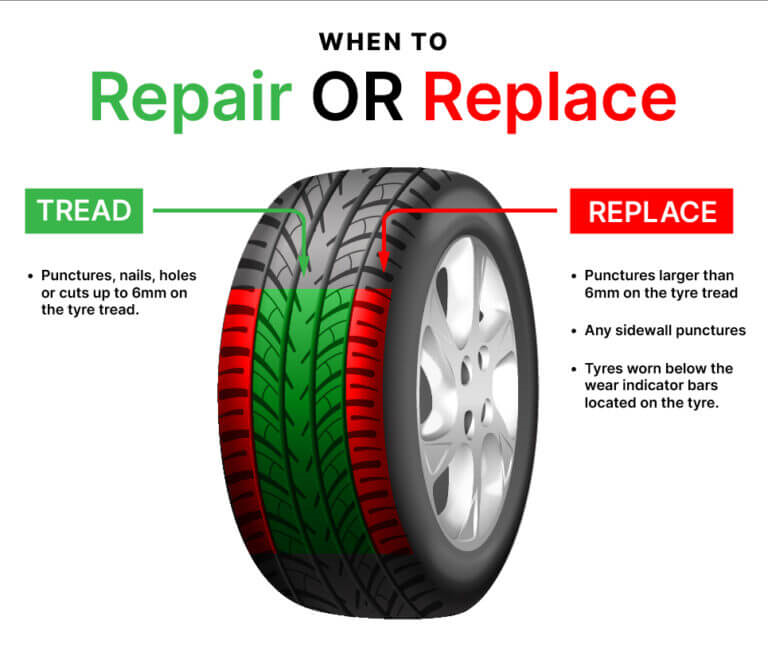
Quick answer: A tire can usually be patched if the puncture is in the main tread, smaller than about a quarter inch, and the tire wasn’t driven on flat. Sidewall or shoulder damage, bulges, visible cords, or low tread mean replacement — no matter how new the tire looks. Location decides it more than size.
A flat doesn’t automatically mean a new tire. Plenty of punctures are safe, cheap, permanent repairs — and plenty of “small” ones are replacements waiting to be diagnosed. What decides it isn’t how bad the damage looks from the driveway. It’s where the hole is and what happened to the tire after it went flat.
When a patch is the right call
A tire is generally repairable when all of these line up:
- The puncture sits in the main tread — not the shoulder or sidewall
- The hole is roughly a quarter inch (6 mm) or smaller
- There’s still good tread left on the tire
- It wasn’t driven on while flat
- The inside checks out clean once the tire comes off the wheel
Nails and screws picked up mid-tread are the textbook case — most of them repair cleanly. The proper fix is a combination patch-plug installed from the inside of the tire, not a plug jammed in from outside or a can of sealant.
When replacement is the only safe answer
Some damage rules out repair entirely, at any price:
- A puncture or cut in the sidewall or shoulder
- A bubble, bulge, or blister anywhere on the sidewall
- A large cut, gash, or split
- Tread already down near the wear bars
- Visible cords or steel belts
- Damage from driving on it flat or badly underinflated
- Multiple punctures close together, or a second repair in the same spot
Why location trumps size
The center tread is backed by steel belts, which give a patch something solid to anchor against. The sidewall has no such backing — it flexes thousands of times every mile, so no repair there will hold, and a failed sidewall repair lets go without warning at speed. That’s why a tidy-looking puncture near the shoulder often means replacement while an uglier nail dead-center is an easy fix. The spot drives the decision, not the appearance.
Roadside fixes are for getting home, not for keeps
A plug kit or a can of sealant exists to get you off the shoulder and to a shop — that’s the whole job description. An external plug doesn’t seal the tire’s inner liner, and sealant can mask the real damage while making a proper inspection messier. Use them when you need them, then have the tire looked at properly. Our comparison of plug vs. patch vs. replace breaks down exactly why the patch-plug is the only repair that counts as permanent.
The inside of the tire has the final say
Damage that looks trivial from outside can be severe once the tire is dismounted. Even a short drive on a flat can grind the inner liner apart in a way you’ll never spot from the driveway. That’s why an honest repair-or-replace verdict requires pulling the tire off the wheel and inspecting the inside — anything less is a guess.
Patch-or-replace questions
How much does a tire repair cost compared to a new tire?
A proper patch-plug runs a small fraction of a new tire’s price — which is exactly why it’s worth repairing whenever the damage qualifies. When it doesn’t qualify, we’ll show you why and help you weigh replacement options.
Can a tire be patched twice?
Sometimes — if both repairs are in the tread area and well apart from each other. Repairs close together or overlapping weaken the structure, and at that point replacement is the safer spend.
Should I pull the nail out of my tire?
No — if the tire is holding air, leave the nail where it is and drive gently to a shop. Pulling it lets the air out fast and can turn a slow leak into a flat on the spot. Just don’t put the visit off: driving low or flat is how repairable tires become replacements.
Not sure which side of the line your tire falls on? Bring it to Payless Tire and we’ll give you a straight answer — what’s safe, and what makes sense for your budget. Stop by 406 Virginia St, Tappahannock, VA, see our services page, or call for an appointment at (804) 443-4063.
Related guide: Tire Plug vs. Patch vs. Replace: Which Is Actually Safe?.