
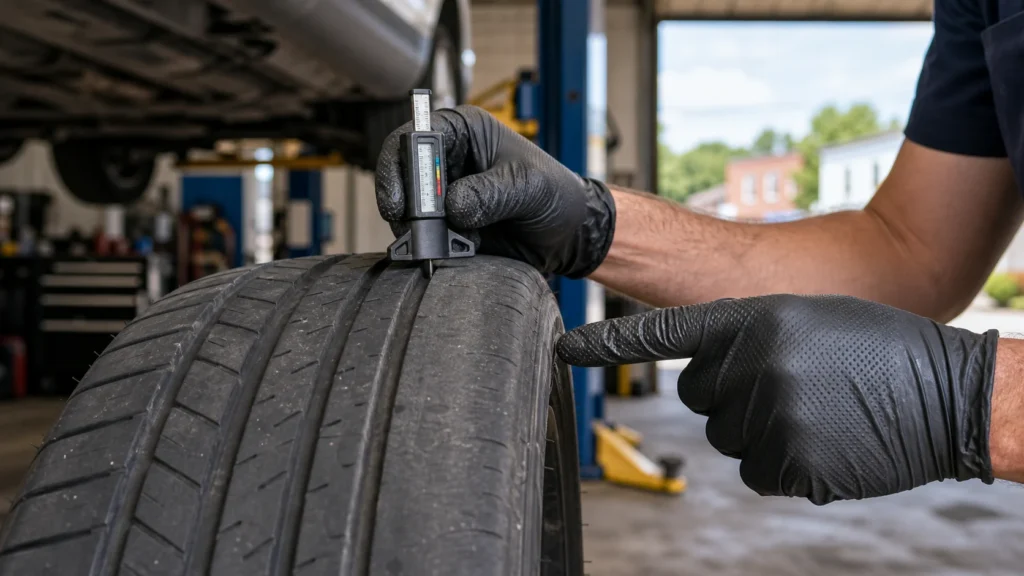
Uneven tire wear never announces itself. The ride gets a touch rougher, the steering pulls a hair to one side, one tire starts looking more tired than its neighbors. Most drivers notice the symptom and never find the cause — and that gap is precisely where a $90 alignment quietly turns into a $700 set of tires. Here’s how to catch it while it’s still the cheap version of the problem.
Your tire is the messenger, not the problem
In most cases the tire didn’t fail — something else wore it out. Low pressure, missed rotations, drifting alignment, tired suspension parts, or a balance issue all destroy tread faster than normal driving ever would. We see the sequel constantly: a driver replaces one worn tire, and a few months later the new one comes back wearing the exact same pattern. The tire was never the problem; the cause was never fixed.
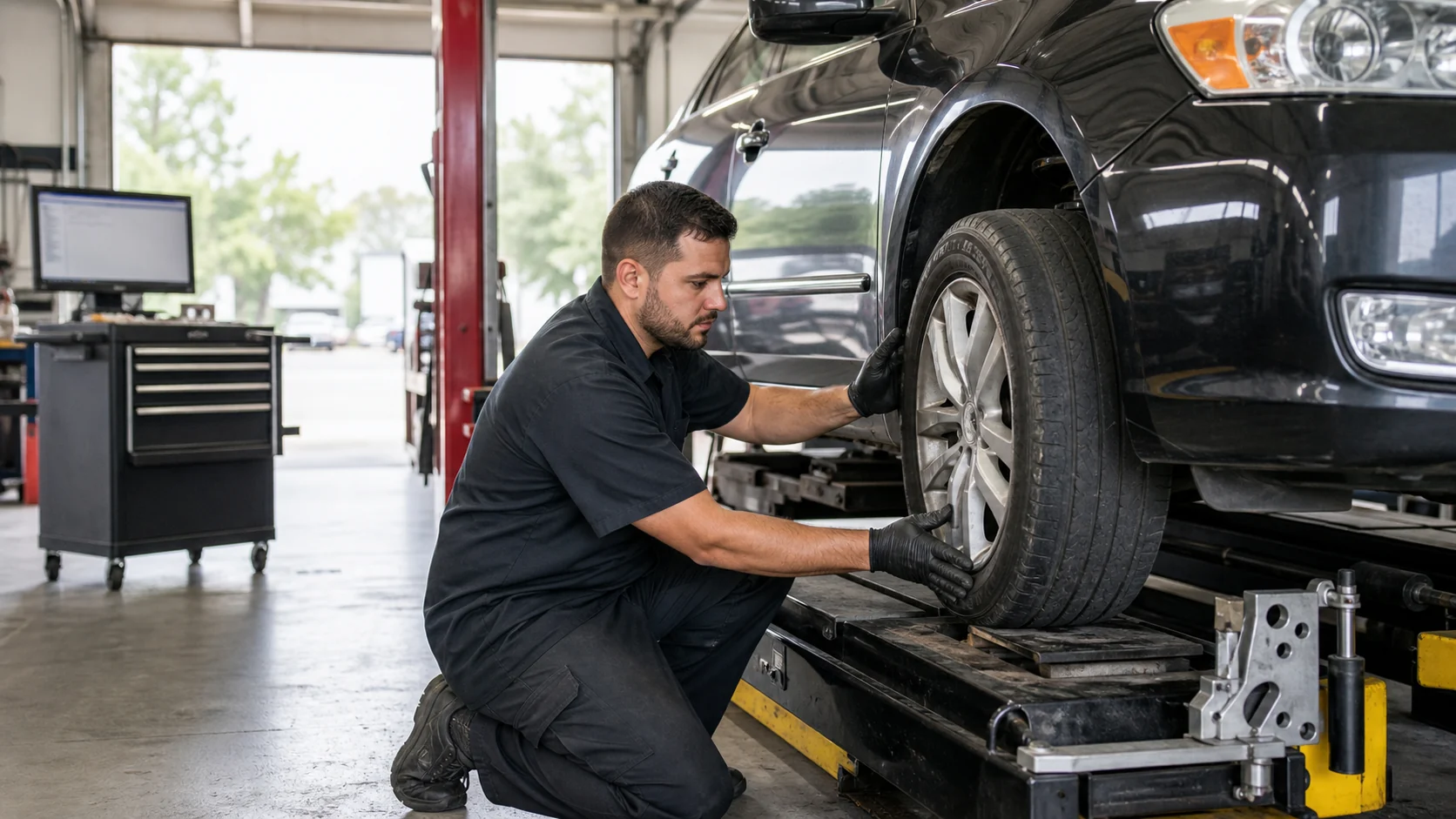
What each wear pattern is telling you
The tread wears in the shape of whatever is wrong. Learn to read it and you’ll fix the right thing the first time:
- One edge worn only: alignment out of spec — camber or toe
- Worn down the center: overinflation riding the car on the middle of the tread
- Both outer edges worn: underinflation loading the shoulders
- Cupping or scalloped dips: worn shocks or struts, often with a balance problem alongside
- Feathering (tread blocks ramped sharp on one side): a toe alignment issue
- Flat spots: hard braking, a locked wheel, or long-term parking in one position
For a deeper dive with a fix-by-fix breakdown, see our companion guide on how to read tire wear patterns.
The two cheapest problems cause the most damage
Pressure and alignment ruin more tires than everything else combined, and both are almost free to stay ahead of. Tires lose air steadily on their own — faster in cold weather — so a set that was perfect in October can be riding on its shoulders by January. Alignment gets knocked out by ordinary life: potholes, curbs, rough pavement. Neither one announces itself, and both eat tread every single mile until they’re corrected.
Around here, it happens faster
Tappahannock roads pile on the risk factors: potholes and patched pavement, highway miles on Route 360, bridge traffic, summer heat, and heavy rain. One hard pothole strike can pull the alignment out of spec and start an edge-wear pattern that costs you a tire if nobody spots it. Local driving is exactly the kind that rewards a quick tread check every month.
The point where waiting gets expensive
The costliest mistake is waiting because the car “still drives fine.” That’s how usable tread disappears and a simple alignment becomes a full set of tires. Get it checked promptly if you see exposed cords, a bulge, severe edge wear, or one tire wearing much faster than the rest — or if you feel a hard pull, loose handling in the rain, or a shake at highway speed. Those last two often travel together.
What drivers ask about uneven wear
Can uneven wear be fixed, or do I need new tires?
Depends how far it’s gone. Caught early, correcting the cause — alignment, pressure, or a worn part — plus a rotation can even things back out. Once a tire is badly worn in one spot or showing cords, it’s done. Either way, the cause has to be fixed or the next tire wears identically.
How do I prevent uneven tire wear?
Three habits cover almost all of it: keep the pressure at the door-sticker spec, rotate every 5,000 to 7,500 miles, and get the alignment checked yearly or after any hard pothole hit or new pull in the steering.
What does an alignment cost compared to new tires?
A small fraction — which is the entire argument for catching wear problems before they eat the tread. The alignment is the cheap version of this problem; the tires are the expensive one.
If your tires are wearing unevenly, bring the car to Payless Tire in Tappahannock. We’ll read the pattern, explain the cause, and fix it before it costs you more. Stop by 406 Virginia St, use our contact page, or call (804) 443-4063.
Related guide: How to Read Tire Wear Patterns: What Each One Is Telling You.