
Quick answer: Rotate your tires every 5,000 to 7,500 miles — for most drivers, that’s every oil change or every other one. If you tow, haul, or do lots of stop-and-go driving, stay at the early end of that window.
Tire rotation is the cheapest tire service there is, and it’s also the one that saves drivers the most money over the life of a set. Move the tires to new positions on a regular schedule and they wear evenly, grip longer, and ride quieter. Skip it, and the pair doing the hardest work wears out years before the other two — and you end up paying for tires that still had life left in them.

How often to rotate tires: the working rule
Every 5,000 to 7,500 miles covers the vast majority of cars, trucks, and SUVs. The easiest way to never forget: tie it to your oil changes. Your owner’s manual has the exact interval for your vehicle, and a tire shop can fine-tune it based on the tires you’re running and how you drive.
Certain driving habits eat tires faster and call for the shorter interval — heavy loads, towing, lots of short stop-and-go trips, or big weekly highway miles. Rough pavement does the same thing, which is worth keeping in mind on the roads around here.
Why skipping rotation costs real money
Front and rear tires never wear at the same rate. On a front-wheel-drive car, the fronts do the steering, most of the braking, and all of the accelerating — they can wear two or three times faster than the rears. Rotation spreads that workload across all four tires so the whole set reaches the end of its life together, instead of you buying two tires early, twice.
There’s a quieter benefit too: every rotation puts your car on a lift with a technician looking at each wheel. That’s when someone spots the nail you never noticed, the alignment that’s starting to drift, or the wear pattern that’s about to become a problem — all while they’re small and cheap to fix.
Clues you’ve waited too long
- Noticeably more tread on the rear tires than the front (or vice versa)
- The car drifts or pulls slightly on a flat road
- A hum or road noise that’s grown louder over time
- A vibration that shows up at higher speeds
- You genuinely can’t remember your last rotation
One caveat: if the car is shaking, rotation alone may not cure it. Our guide on why your car shakes at highway speeds covers what else could be going on.
What you should get with a proper rotation
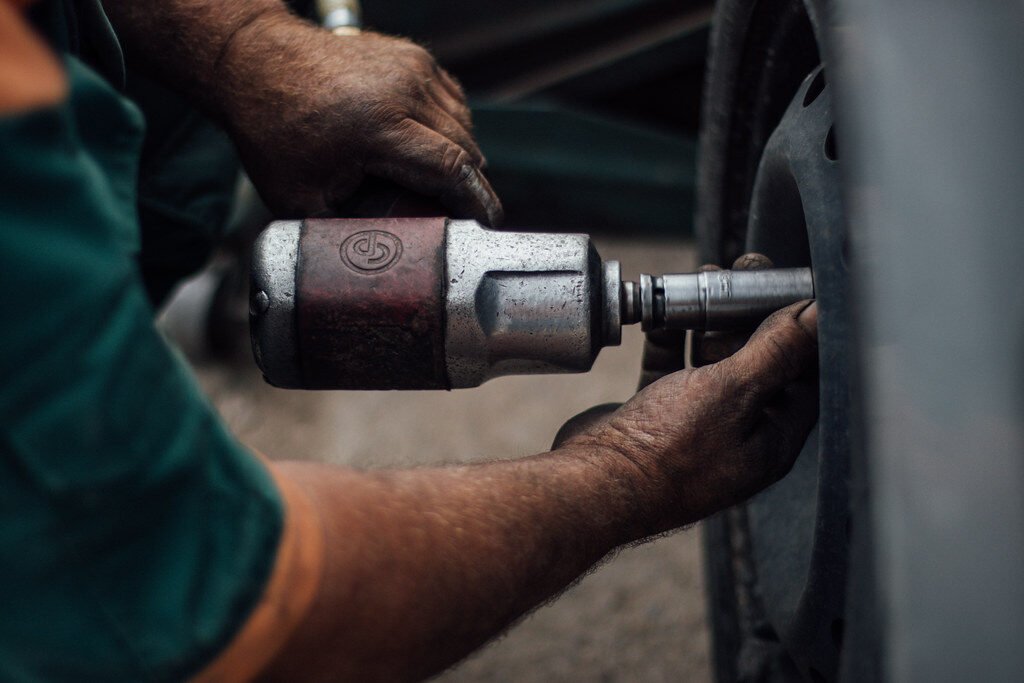
Done right, a rotation is a mini tire inspection, not just musical chairs for wheels. The tech should check tread depth and wear patterns at all four corners, look each tire over for damage, set every tire to the correct pressure, and torque the lug nuts to spec — that last step protects both your wheels and your brake rotors. If a shop hands the car back in five minutes without touching a gauge or a torque wrench, you got half the job.
When wear points to something rotation can’t fix
Rapid edge wear, cupping, or a vibration that returns after balancing usually means alignment or suspension trouble underneath. Rotation slows the damage but doesn’t stop it — the underlying cause has to be fixed or it just keeps eating tread. And if the tread is already low, our guide on when to replace your tires walks through the warning signs that matter.
A note for Tappahannock drivers
Local roads don’t do tires any favors. Route 360, the back roads toward Warsaw, Montross, and Bowling Green, potholes, patched pavement, the occasional curb — it all adds up, and small wear problems become big ones quickly out here. A steady rotation schedule is the simplest defense you have.
Rotation questions we hear a lot
Can I rotate my tires myself?
Sure — if you have a solid jack, jack stands, and a torque wrench. The two things DIY rotations most often miss are proper lug-nut torque and the inspection while the wheels are off. If you’re not set up for both, a shop rotation is cheap and includes the looking-things-over part.
What actually happens if I never rotate?
The hardest-working tires — usually the fronts — wear out first, so you replace in pairs more often. The ride gets noisier, rain traction drops on the worn pair, and many tire mileage warranties are voided by skipped rotations, which stings when a tire wears out early.
Does the rotation pattern matter?
Yes — the correct pattern depends on your drivetrain, whether the tires are directional, and whether front and rear sizes match. Get it wrong on directional tires and you’ll hurt wet grip and add noise. Our full guide on tire rotation patterns explains which one your setup needs.
Can’t remember your last rotation? That’s the sign. Swing by Payless Tire at 406 Virginia St in Tappahannock and we’ll check your tread, set a schedule that fits your vehicle, and catch anything else going on while the wheels are off. See our services page, contact us, or call (804) 443-4063.
Related guide: Tire Rotation Patterns Explained: FWD, RWD, AWD and Directional Tires.