
Quick answer: The right rotation pattern depends on your drivetrain and your tires. Front-wheel drive uses the forward cross; rear- and all-wheel drive use the rearward cross; the X-pattern suits many cars. Directional tires only move front-to-back on the same side, and staggered setups (different front/rear sizes) can only swap side-to-side.
Rotating your tires the wrong way can be nearly as bad as not rotating them at all — cross a set of directional tires to the wrong side and you’ve quietly ruined their wet grip. The pattern isn’t trivia; it’s matched to how your car sends power to the road and how your tires are built. Here’s which one your setup needs and why.
The interval, briefly
Every 5,000 to 7,500 miles works for most vehicles — pin it to every oil change or every other one. Towing, heavy loads, stop-and-go driving, and high highway mileage all argue for the shorter end. (For the full case on why the interval matters, see our guide on how often to rotate your tires.) Your owner’s manual has the exact number for your vehicle.
The three standard patterns
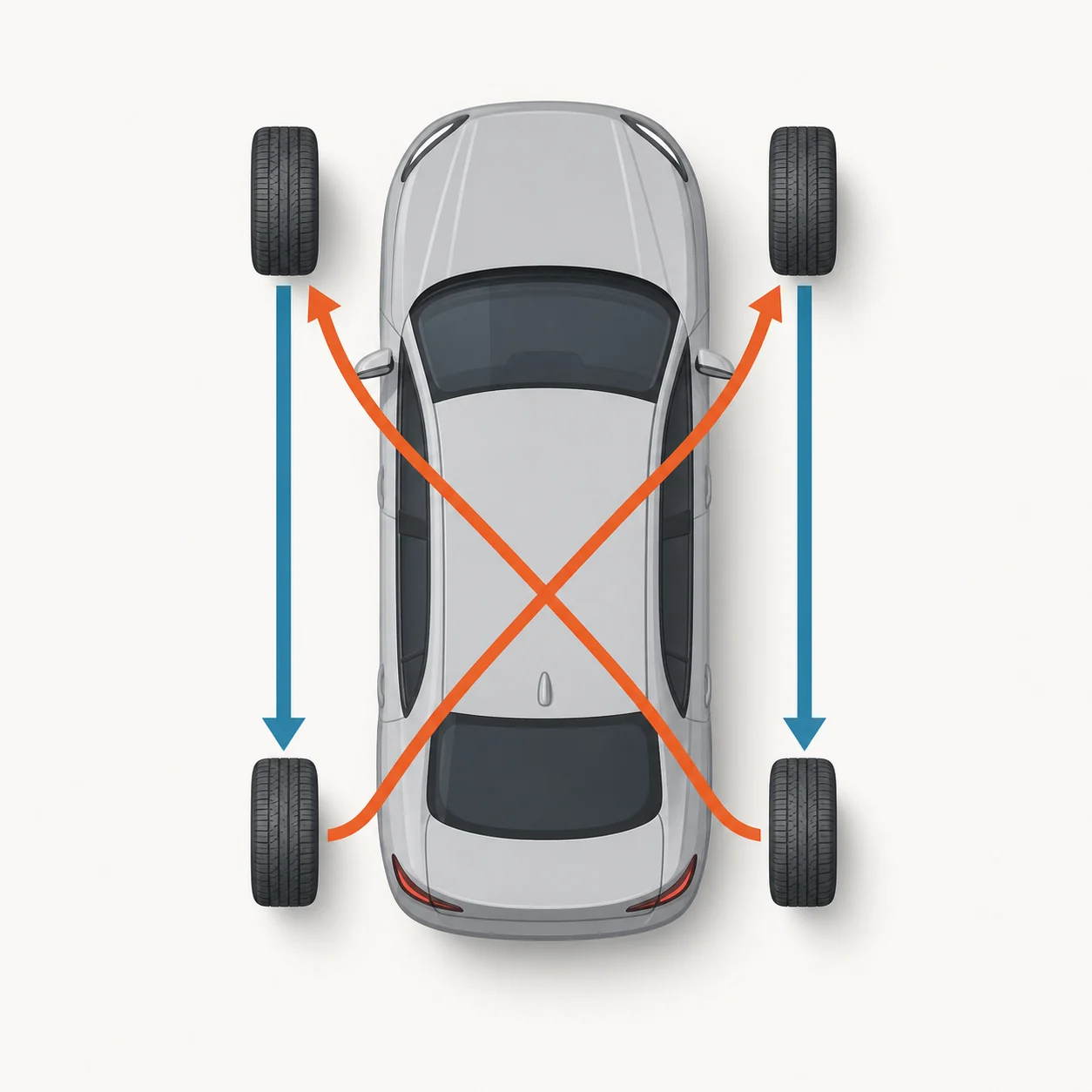
For tires that are the same size all around and non-directional, the drivetrain picks the pattern:
- Forward cross (front-wheel drive): front tires move straight back; rear tires cross to the opposite front corners.
- Rearward cross (rear- and four-/all-wheel drive): rear tires move straight forward; front tires cross to the opposite rear corners.
- X-pattern (many FWD cars and light vehicles): all four tires cross diagonally to the opposite corner.
The two setups that break the rules
Get these wrong and you can damage tires or hurt handling:
- Directional tires (look for an arrow or “rotation” marking on the sidewall — the tread is designed to spin one way): rotate front-to-back on the same side only. Crossing them reverses their rotation direction, which kills wet grip and adds noise, unless they’re dismounted and remounted on the wheel.
- Staggered fitments (wider rear tires than front, common on performance cars): the sizes can’t move front-to-back, so the only option is side-to-side on the same axle — and only if the tires aren’t also directional. Staggered and directional together means no rotation at all without remounting.
Find your setup in the table
| Your setup | Recommended pattern |
|---|---|
| Front-wheel drive, same-size non-directional tires | Forward cross (or X-pattern) |
| Rear- or all-wheel drive, same-size non-directional tires | Rearward cross |
| Directional tires (any drivetrain) | Front-to-back, same side |
| Staggered (different front/rear sizes) | Side-to-side per axle, or not at all if also directional |
| Includes a full-size matching spare | Work the spare into the rearward cross (5-tire rotation) |
Why the effort pays off
Front and rear tires never wear at the same rate — steering, braking, drivetrain, and weight distribution all lean harder on some corners than others. On a front-wheel-drive car the fronts do nearly everything, and wear accordingly. Rotation spreads the load so all four tires finish together instead of the front pair dying young. Bonus: every rotation puts the car on a lift where a technician can catch a nail, a pressure problem, or early uneven wear while it’s still cheap.
What the full job includes
A rotation done properly is also an inspection: tread depth and wear patterns checked at each corner, every tire examined for damage, pressures set to spec, and lug nuts torqued to the manufacturer’s number — the step that protects your wheels and keeps brake rotors from warping under uneven clamping force.
Rotation pattern FAQs
Can I rotate my tires myself?
Yes, with a proper jack, jack stands, and a torque wrench. The two things DIY rotations most often miss are correct lug-nut torque and the inspection while the wheels are off. If you’re not equipped for both, a shop rotation is cheap and includes them.
How do I rotate directional tires?
Front-to-back on the same side of the car, never diagonally. The sidewall arrow has to keep pointing in the direction of travel. Moving them across the car requires dismounting and remounting each tire on its wheel.
What happens if I never rotate my tires?
The hardest-working tires — usually the fronts — wear out early, so you buy tires in pairs more often. The ride gets noisier, wet traction fades on the worn pair, and skipped rotations void the mileage warranty on many tires.
Does the rotation pattern really matter?
Yes. The wrong pattern — especially crossing directional tires — can raise road noise, cut wet grip, and cause uneven wear. Matching the pattern to your drivetrain and tire type is the entire point of doing the job right.
If you can’t remember your last rotation, have a shop check your tread, set the right interval for your vehicle, and use the correct pattern for your setup. Rotation plus correct pressure plus the occasional alignment check is the cheapest formula there is for long tire life.
More tire guides: How to Read Tire Wear Patterns, Solid vs. Flashing TPMS Light, or browse the full Tire Guide.