
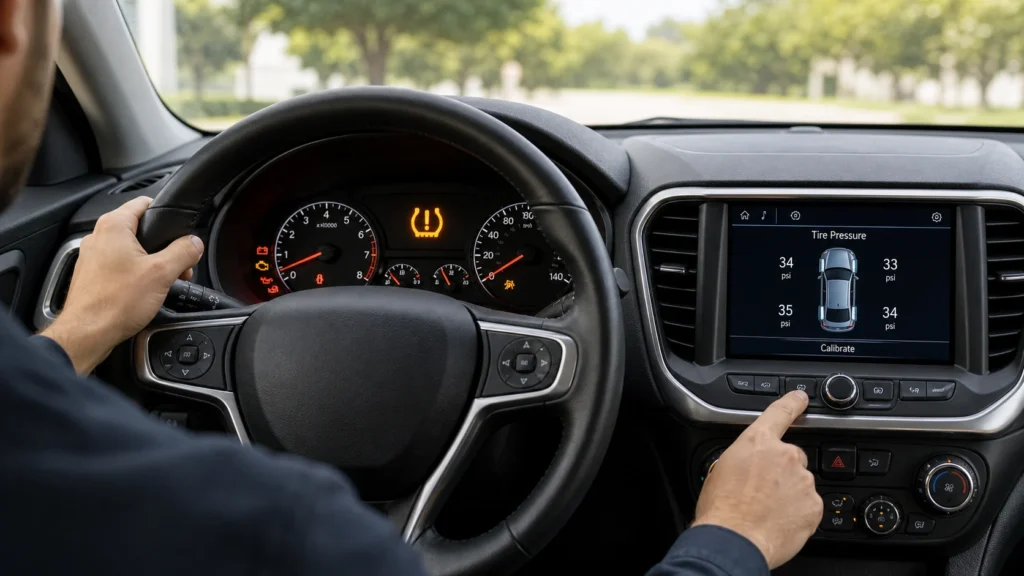
Quick answer: First set all four tires to the door-sticker pressure — then drive a few miles at 15+ mph and most tire pressure lights reset themselves. If yours doesn’t, use your car’s reset procedure: a TPMS reset button (often under the dash), a menu option in the driver display, or a relearn sequence from the owner’s manual. A light that still won’t clear, or that flashes at startup, needs a sensor scan.
The right way to reset a tire pressure light starts with an unpopular truth: the light isn’t the problem. It’s a messenger, and “resetting” it without fixing the pressure just silences a warning you paid for. Do the two-minute air check first — then, if the light lingers, here’s every way to clear it.
Step 0: Fix the actual pressures
Gauge all four tires cold and fill each to the number on the driver’s-door placard — not the tire sidewall. This step “resets” the majority of pressure lights all by itself, because most systems clear automatically within a few miles once they see correct pressures. If you skip this and force a reset instead, the light returns immediately (or worse, the system recalibrates to your low pressures — more on that below). The right technique is in our guide on tire pressure checks.
If the light stays on: reset procedures by system
Vehicles clear TPMS lights a few different ways — the owner’s manual (or a search for your model + “TPMS reset”) tells you which yours uses:
- Automatic: most direct-sensor systems clear on their own after a few miles above ~15 mph with correct pressures. No button exists because none is needed.
- TPMS reset button: common on Toyotas and others — usually under the steering column or in the glovebox. With the ignition on, hold it until the light blinks three times, then drive for the system to relearn.
- Menu reset: many newer vehicles bury it in the driver information center or touchscreen under Vehicle Settings → Tires/TPMS → Calibrate or Reset.
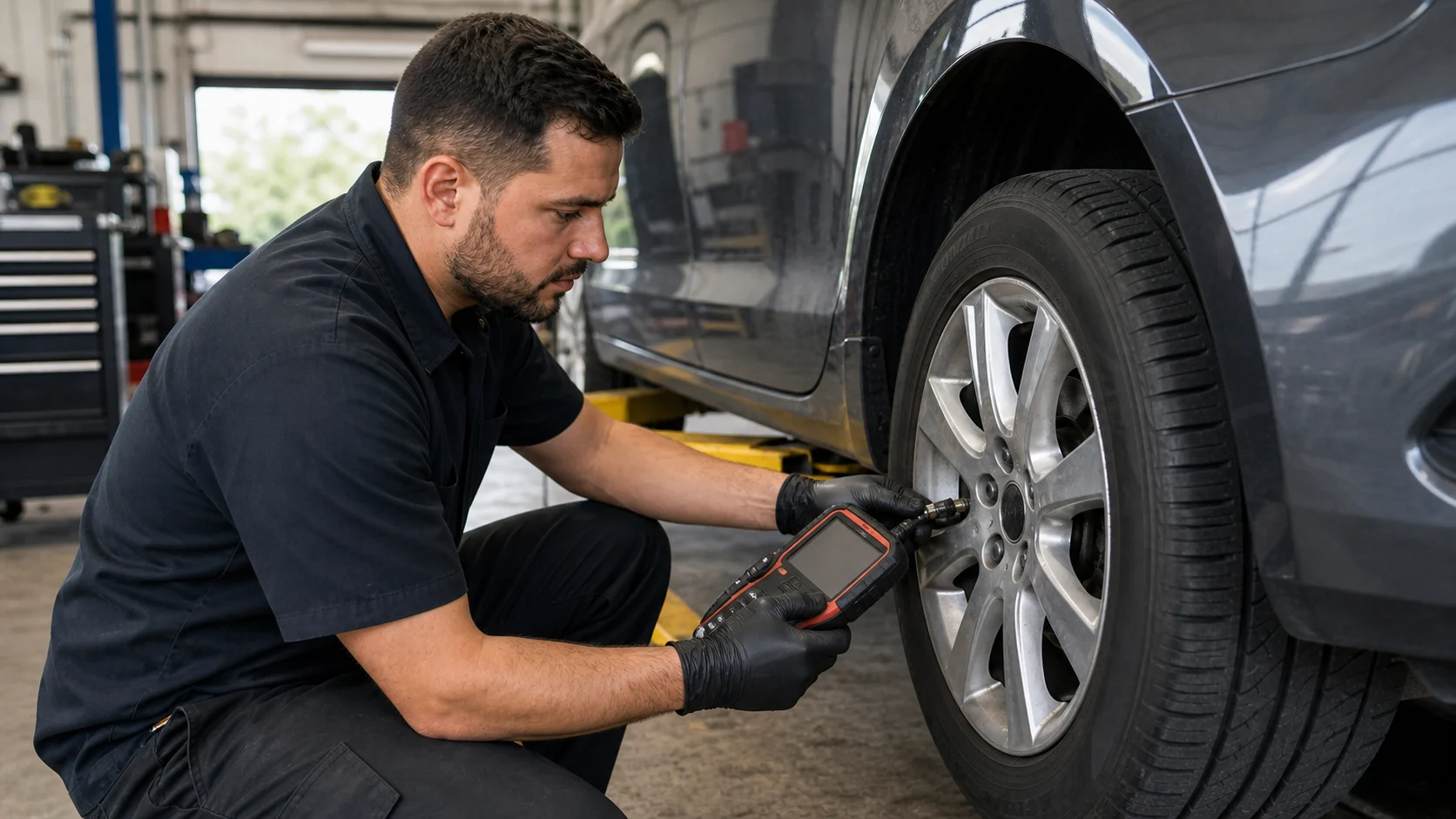
- Relearn sequence: some vehicles (many GMs) want a formal relearn after wheels move — via menu or a TPMS tool, with horn chirps confirming each corner.
- Indirect systems (no wheel sensors — the car infers pressure from wheel speeds): these always need a manual reset after you adjust pressures, since the system calibrates to “current state = correct.”
The warning about reset buttons
On systems that calibrate to current pressures, pressing reset while a tire is low teaches the car that low is normal — the light turns off and the protection turns off with it. This is why step 0 isn’t optional, and why “just show me how to make the light go away” is the one request a good shop will gently push back on.
When no reset will hold
Three situations mean the light is beyond DIY resets:
- It flashes for 60–90 seconds at startup: a sensor fault — typically a dead sensor battery. The full breakdown is in our solid vs. flashing TPMS light guide.
- It returns within days of correct inflation: a slow leak — nail, valve stem, or bead corrosion. The tire needs inspecting, not the light resetting.
- It came on right after tire work or a seasonal wheel swap: the sensors likely need a relearn to their new positions — the installing shop should handle it.
Reset questions
Why is my tire pressure light still on after filling the tires?
Give it a few miles of driving first — most systems need to see the corrected pressures in motion. Still on? Either your car wants a manual reset (check the manual), one tire is lower than your gauge says, or a sensor has failed.
Where is the TPMS reset button?
If your car has one, it’s usually below the steering wheel near the fuse panel, or in the glovebox. Many cars don’t have one at all — they reset automatically or through the settings menu instead.
Can I drive with the light on if I know the tires are fine?
You can, but “the tires are fine” and a lit TPMS light contradict each other — one of them is wrong. Either a tire is lower than you think or a sensor has died, and both are worth a quick shop visit. In the meantime you’re driving without the early-warning system.
Does disconnecting the battery reset the TPMS light?
Generally no — and it’s the wrong tool anyway. TPMS faults live in the TPMS module, and the light relights as soon as the fault is re-detected. Fix the cause; the light follows.
Light won’t quit near Tappahannock? Bring it to Payless Tire, 406 Virginia St — we’ll set the pressures, scan the sensors, find any leak, and send you off with the light dark for the right reason. Call (804) 443-4063 or use our contact page.