
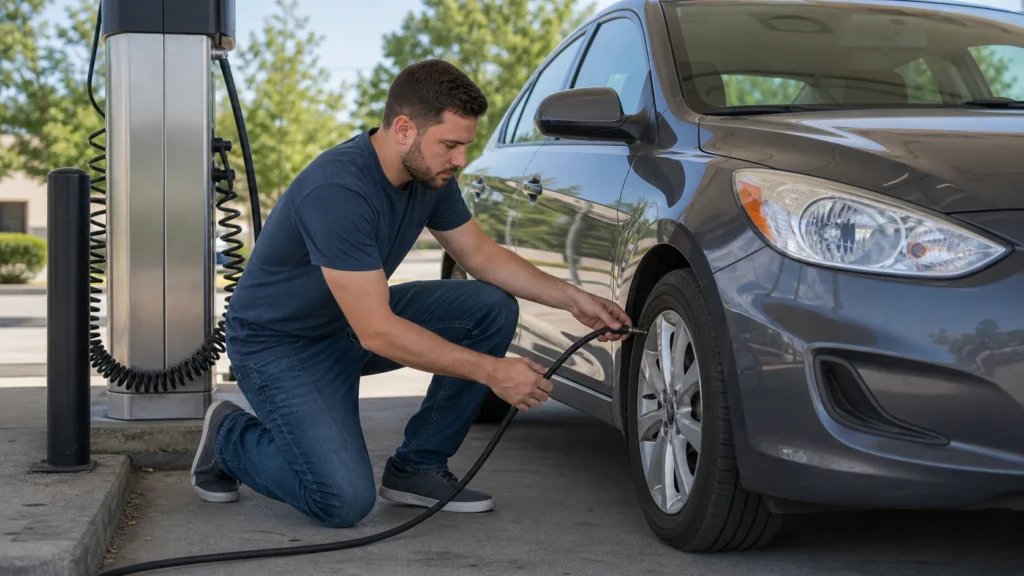
Quick answer: Find your car’s correct pressure on the sticker inside the driver’s door (not the tire sidewall), unscrew the valve cap, press the air hose onto the valve stem until the hissing stops, and fill in short bursts — checking with a gauge between bursts — until you hit the number. Two minutes per tire, usually $1.50 or free.
Nobody teaches this one; you’re just expected to know it the first time a pressure light comes on at a gas station. So here’s the complete version — where the air machine is, which number to fill to, and the two small mistakes that make people think the machine is broken.
Step 1: Get the right number before you start
Open the driver’s door and find the tire placard on the jamb — it lists the recommended cold pressure, usually 30–35 psi for passenger cars, sometimes different front and rear. Ignore the number on the tire sidewall; that’s the tire’s maximum pressure, not your car’s specification, and filling to it gives you a harsh ride and a tire that wears out its center. This one mix-up causes more overinflated tires than everything else combined.
Step 2: Find air
- Gas stations: the air machine is usually near the edge of the lot. Many take cards or quarters ($1.50–$2 for a few minutes); some states (like Connecticut and California in many cases) require free air with a fuel purchase — and plenty of stations will switch it on free if you ask.
- Tire shops: most, including ours, will top off your tires free — it takes a tech two minutes.
- Home compressor: a $30–$50 portable inflator that plugs into a 12V outlet pays for itself in convenience the first cold snap.
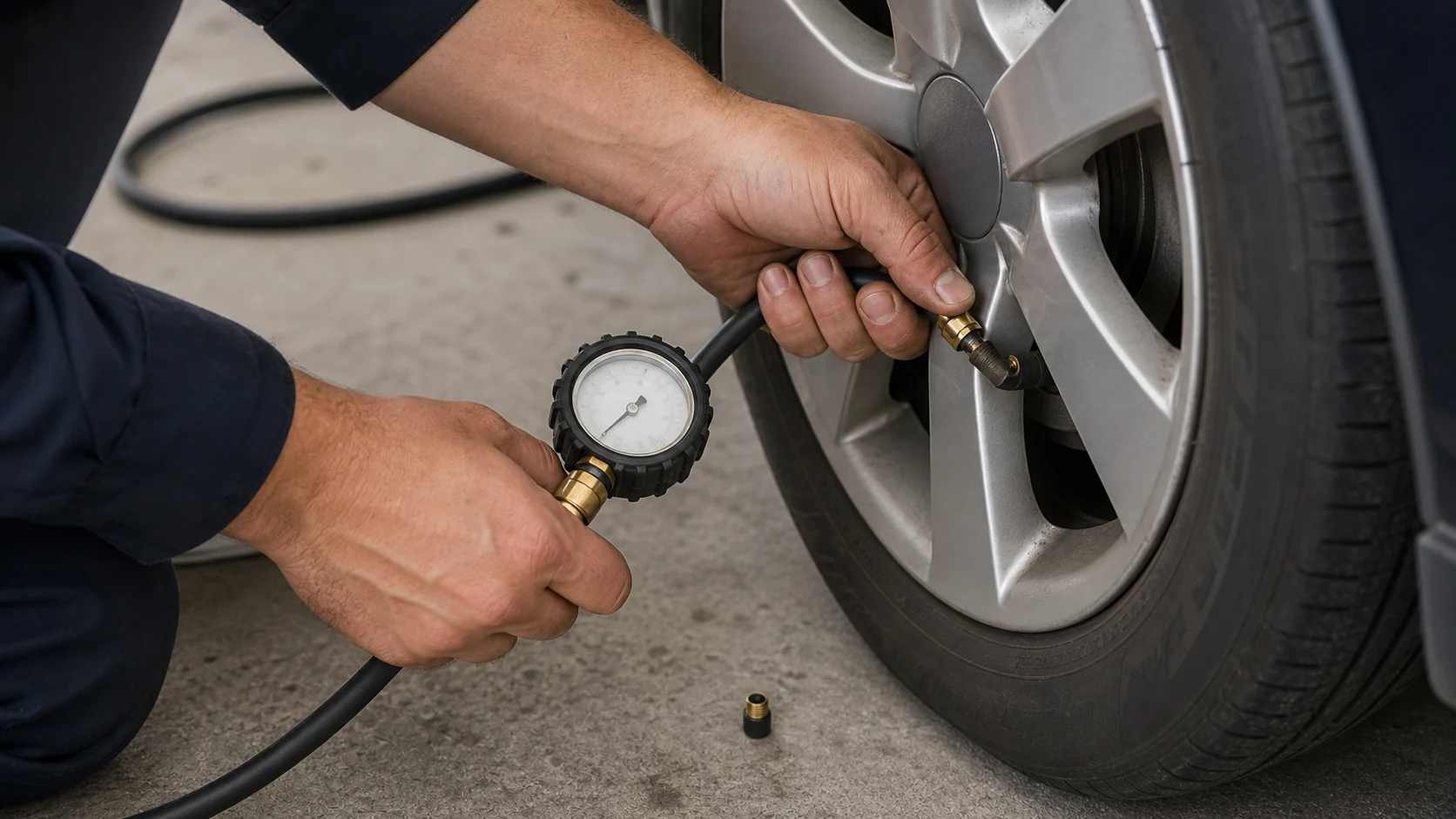
Step 3: Fill, in short bursts
- Park so the hose reaches all four tires — they all get checked while you’re at it.
- Unscrew the valve cap and pocket it somewhere it can’t roll away.
- Press the chuck (the hose end) straight onto the valve stem, firmly. Loud hissing means it’s crooked — re-seat it until the hiss mostly stops and air is flowing in, not out.
- Fill for 5–10 seconds at a time, then check with a gauge. Machines with built-in gauges work; a $5 pocket gauge is more trustworthy.
- Overshot? Press the small pin inside the valve stem with the gauge’s nub or a fingernail to bleed air out, then re-check.
- Cap goes back on. Repeat for the other three — and the spare, if you can reach it.
The cold-tire fine print
Pressure specs assume cold tires — before driving, or after a couple hours parked. Driving warms the air inside and raises the reading 2–4 psi, so if you’ve just driven 20 minutes to the gas station, filling to the sticker number actually leaves you slightly low once the tires cool. The practical fix: if the tires are warm, fill 2–3 psi above the sticker number. And re-check monthly, because tires lose about 1 psi per month naturally — plus 1 psi for every 10°F the temperature drops, which is why the first cold week of fall sets off pressure lights all over town. The full habit is covered in why tire pressure checks matter.
After filling: the light
The TPMS light usually clears itself after a few miles of driving once pressures are correct. If it doesn’t — or it’s back within days — you’re not dealing with a top-off problem anymore. A light that keeps returning means a slow leak, and a light that flashes at startup means a sensor issue; our guide on what the TPMS light means sorts out which you have.
Air-up questions
How much air do I put in my tires?
Whatever the driver’s-door sticker says — typically 30–35 psi. Not the sidewall number, and not a round number someone told you once. Front and rear can differ, so read both lines.
Why does the air machine seem to let air OUT of my tire?
The chuck isn’t seated square on the valve stem, so air escapes around it faster than it goes in. Press straight and firm until the hiss quiets. On stubborn stems, angle the hose so it approaches the stem straight-on.
Can I overinflate a tire by accident at a gas station?
You’d have to try — but modest overinflation happens all the time. It rides harsh and wears the tread’s center. That’s why you check with a gauge between bursts and bleed off any extra with the valve pin.
Do I need to fill my tires with nitrogen instead of air?
Regular air is 78% nitrogen already. Pure nitrogen leaks marginally slower, but for everyday driving the difference doesn’t justify hunting for a nitrogen station. Correct pressure, checked monthly, matters far more than what the gas is.
Rather have someone else handle it? Roll into Payless Tire, 406 Virginia St, Tappahannock — we’ll check and set all four (and the spare) free, and take a quick look at the tread while we’re down there. Call (804) 443-4063 or see our services page.